AI Business
AI Consultant vs Automation Specialist vs Prompt Engineer

The most common mistake people make when starting out with AI is focusing on tools rather than roles. They learn ChatGPT, then Claude, then Midjourney, accumulating capabilities without a clear direction for how those capabilities translate into income. The tools are not the product. The role is the product. The role defines the problem you solve, the client you serve, the value you deliver, and the price you can charge. Three distinct roles have emerged as the clearest income paths for people building careers or businesses around AI without a technical background. They share a starting point, which is that all three use AI tools and none require coding knowledge. Beyond that, they diverge significantly in what they actually do, what they deliver to clients, and what the market pays for each. Understanding where AI roles fit within the full range of income opportunities available is worth establishing before committing to a direction.
Why the Role You Choose Matters More Than the Tools You Learn
The most common mistake people make when starting out with AI is focusing on tools rather than roles. They learn ChatGPT, then Claude, then Midjourney, accumulating capabilities without a clear direction for how those capabilities translate into income. The tools are not the product. The role is the product. The role defines the problem you solve, the client you serve, the value you deliver, and the price you can charge. Three distinct roles have emerged as the clearest income paths for people building careers or businesses around AI without a technical background. They share a starting point, which is that all three use AI tools and none require coding knowledge. Beyond that, they diverge significantly in what they actually do, what they deliver to clients, and what the market pays for each. Understanding where AI roles fit within the full range of income opportunities available is worth establishing before committing to a direction.
The Question That Determines Which Path Fits
Before comparing the three roles, the most useful question to answer is what kind of work creates the most energy for you. Do you enjoy sharpening the quality of outputs, refining language, and improving the way AI responds to complex briefs? That points toward prompt engineering as a skill set. Do you find satisfaction in connecting systems, automating repetitive processes, and building workflows that run without manual intervention? That points toward automation. Do you prefer working at the level of business problems, advising on strategy, and helping organisations decide where and how AI should be applied? That points toward consulting. The honest answer to that question is a better starting point than any earning potential comparison.
How the Three Roles Compare
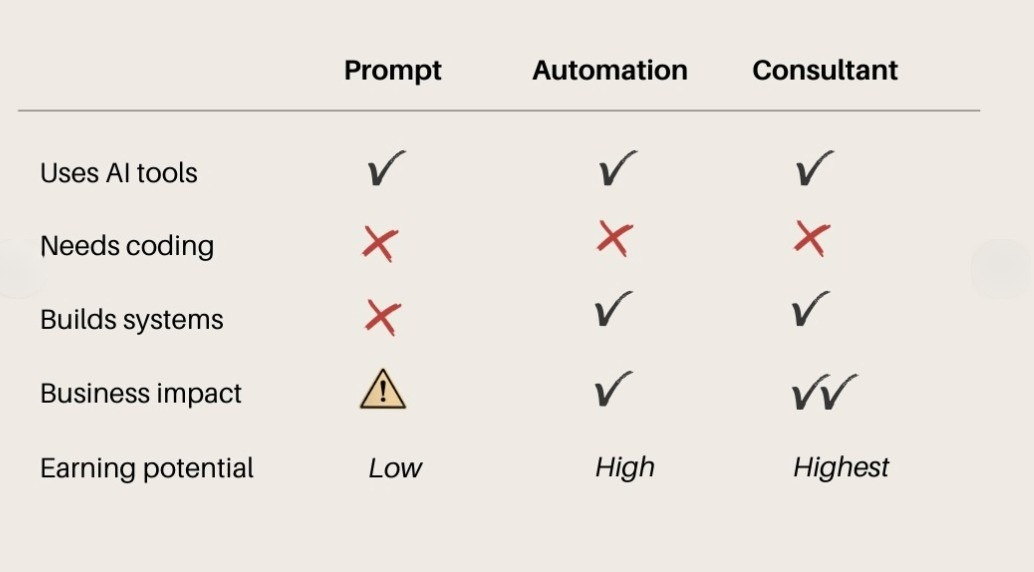
The comparison makes one thing clear immediately: prompt engineering as a standalone service has the lowest ceiling of the three. Both automation and consulting build systems that produce measurable business outcomes, which is what clients pay premium rates for. The difference between automation and consulting is primarily one of scope and seniority, with consulting commanding higher rates because it combines the strategic layer with the execution layer.
Prompt Engineer: What It Really Is and What It Pays
Prompt engineering became a widely discussed concept when large language models first became accessible. The idea that writing better prompts was a distinct and highly paid profession spread quickly, and for a short period, it was presented as one of the most valuable skills in the AI economy. The reality that has emerged since then is considerably more nuanced.
What Prompt Engineering Actually Involves
In practice, prompt engineering involves writing more precise and structured instructions for AI tools, improving the quality of outputs for a specific use case, and building libraries of reusable prompts for teams or organisations. It is genuinely useful work and a genuinely valuable skill. The problem is that the market for prompt engineering as a standalone service has proven shallow. Most businesses that need better AI outputs either develop that capability internally, include it as part of a broader AI implementation project, or find that the tools themselves have improved to the point where basic prompt quality matters less than it did two years ago.
The Reality Check
Prompt engineering is best understood as a skill that makes every other AI role more effective rather than as a career in its own right. An automation specialist who writes precise prompts builds better systems. An AI consultant who briefs AI tools with clarity delivers better strategic work. The skill compounds the value of whatever role it is attached to. Trying to sell it as a standalone service in 2026 is difficult because the perceived value is low relative to the effort required to explain it. The earning potential reflects this: prompt engineering services are typically priced at the lower end of AI work, and the ceiling is constrained by the fact that clients struggle to see the direct business outcome they are paying for. That said, for anyone at the very beginning of their AI learning journey, developing strong prompt thinking is the right first step. It builds the structured thinking that underpins both automation and consulting work, and it produces immediate visible improvements in output quality that are motivating to experience. The full framework for building this skill as a foundation for higher-value work is worth understanding early.
Automation Specialist: What It Really Is and What It Pays
The Automation Specialist is the role that most consistently converts AI knowledge into reliable business income in the current market. The work is concrete, the value is measurable, and the demand is growing faster than supply in most industries.
What Automation Specialist Work Actually Involves
An Automation Specialist builds no-code workflows that connect the tools a business already uses and automate the repetitive processes that currently consume employee time. In practice, this means automating email and inbox management, building CRM workflows that handle lead follow-up without manual input, connecting project management tools with communication platforms so updates happen automatically, and creating systems that route data between applications without anyone moving it by hand. The tools most commonly used include n8n, Zapier, Make, Notion, and CRM platforms, none of which require writing code. The specialist learns the logic of each tool, understands how they connect, and builds workflows that produce a measurable reduction in manual effort. For anyone who wants to see exactly what this looks like in practice, the n8n email automation system covered in this article series is a concrete example of what a single automation workflow can do for a business inbox.
Why Companies Pay for This
Companies pay for automation because the return on investment is immediate and quantifiable. If a business is spending ten hours a week on manual data entry, follow-up emails, and administrative routing, and an automation specialist builds a system that eliminates eight of those ten hours, the value is obvious, and the price charged for that system is easy to justify. The specialist does not need to convince the client that AI is important. They need to demonstrate, usually through a discovery conversation and a specific workflow proposal, that a particular process can be automated and that the time saving justifies the cost. That is a much easier sale than most AI services. Earning potential at the automation specialist level is genuinely high. Project fees for building a single automation system typically range from a few hundred to several thousand euros, depending on complexity, and the systems are replicable across multiple clients in the same industry.
AI Consultant: What It Really Is and What It Pays
The AI Consultant operates at the highest level of the three roles in terms of both scope and earning potential. Where the automation specialist solves a specific operational problem, the consultant works at the level of the whole business, identifying where AI should and should not be applied, designing the implementation approach, overseeing execution, and training the teams who will use the systems going forward.
What AI Consulting Actually Involves
An AI Consultant typically begins an engagement by auditing a business to understand where time is being lost, where decisions are being made with incomplete information, where repetitive work is consuming skilled employees, and where the competitive pressure to adopt AI is most acute. From that audit they produce a prioritised recommendation for where AI will create the most business value and a roadmap for implementation. They then either oversee the implementation directly, working with automation specialists and other practitioners, or they manage the process as the strategic lead while practitioners handle the technical execution. Training is a significant part of the consultant role that is often underestimated. Implementing an AI system into a business without ensuring the team knows how to use it, trust it, and maintain it is a common failure mode. The consultant who builds onboarding and training into their engagements produces better long-term outcomes and earns stronger referrals than one who delivers a system and moves on.
Why Companies Pay a Premium for This
The reason AI consulting commands the highest rates of the three roles is that it combines two things companies find difficult to source separately: strategic clarity about where AI creates value and practical knowledge of how to implement it. Most businesses that want to adopt AI face a choice between hiring strategy consultants who do not understand the tools and technical specialists who do not understand the business. An AI consultant who can do both removes that dilemma and justifies a significant premium for doing so. The strategic thinking involved in this role connects directly to the commercial awareness and workflow design capabilities that distinguish high performers across all AI roles.
How to Choose the Right Path for You
The comparison table and the role descriptions give a clear picture of what each path involves and what it pays. The decision of which one to pursue depends on three factors: where your natural strengths sit, how quickly you need income, and what kind of working relationship with clients appeals to you.
Start With Your Strengths
People who are naturally analytical, systems-oriented, and find satisfaction in watching a workflow run without errors tend to thrive as automation specialists. The work is concrete, the feedback is immediate, and the skills compound quickly. People who are strong communicators, comfortable navigating ambiguity, and genuinely interested in how businesses work at a strategic level tend to find the consulting path more energising and more financially rewarding over time. Prompt engineering skills serve both paths and are worth developing regardless of which direction you choose.
Consider Your Timeline
If income is needed within the next 30 to 60 days, automation specialist work is the faster path to a paying client. The service is easier to describe, the value is easier to demonstrate, and the sales conversation is shorter. Consulting engagements take longer to land because they involve a higher level of trust and a more complex buying decision. Building a consulting practice is a medium-term project rather than a quick pivot, and it is more sustainable when it grows from a foundation of proven automation work that demonstrates practical capability.
AI Is Not About Learning Everything
The closing message from the source content of this article is worth holding onto: AI is not about learning everything. It is about choosing the right lane. The people who make the most progress with AI in 2026 are not the ones who have tried every tool or read every newsletter. They are the ones who picked a direction that matched their strengths and the market they want to serve, and then went deep on that specific path until they had something real to show for it.
Final Thoughts
Three roles, three very different earning ceilings, and one thing in common: none of them require a technical background, a computer science degree, or the ability to write code. What they require is a willingness to learn how AI tools work, the clarity to position one specific skill as a service, and the persistence to find the first client who will pay for it. Prompt engineering builds the foundation. Automation specialists' work builds the income. AI consulting builds a career. Many of the strongest practitioners in this space started with prompts, moved into automation as their understanding deepened, and arrived at consulting once they had enough client experience to advise at a strategic level. That progression is not mandatory, but it is a natural one, and understanding where you are on that path is more useful than trying to skip ahead to the highest-earning role before the underlying skills are in place. If you want to build any of these skills with structured guidance and a community of women working toward the same goals, AK Academy is where that work happens.
Start building professional AI skills today.
Explore AK Academy and choose the path that fits your goal: courses, workshops, community, corporate training, or teaching with us.
FAQ