AI Business
Start an AI Content Agency With No Team and No Studio
The word agency used to imply an office, a team, and significant overhead. None of that applies here.
What an AI Content Agency Actually Is
The word agency used to imply an office, a team, and significant overhead. None of that applies here.
Agency Positioning Versus Freelancer Positioning
An AI content agency is a one-person operation that delivers at the output level of a team because AI handles the production layer. The distinction between freelancer and agency is not the size of your operation. It is how you package and present what you deliver. A freelancer sells time and individual assets. An agency sells a result, a system, and an ongoing relationship. That shift changes who reaches out to you, how much they expect to pay, and how long they stay as a client. Understanding where this fits into a broader AI income strategy is worth doing before you build your first offer.
What Clients Are Paying For
Clients who hire a content agency are not buying images. They are buying the confidence that their brand looks right online, consistently, without them having to think about it. The AI is your production engine. Your niche knowledge, your creative direction, and your ability to understand a brand are what justify the price. That combination is what makes this service genuinely different from someone who just opens an image tool and generates pretty pictures, and it is the same principle behind every high-value AI service business.
The Three Services That Build a Real AI Content Agency
Social Media Content Packages
Monthly social media content is the most reliable retainer service in this space. Small businesses, coaches, local brands, and online stores all need a consistent stream of posts for Instagram, LinkedIn, or TikTok. Most produce content inconsistently or at a low quality relative to how good their actual product or service is. That gap is your entry point. A monthly package where you deliver a set number of posts, formatted and ready to publish, solves a problem they have every single month. That recurring nature is what creates predictable income.
Ad Creatives for Paid Advertising
Ad creatives are the single most important variable in whether a paid campaign performs. Brands running paid ads on Meta or TikTok need new creatives constantly because audiences fatigue quickly on repeated visuals. What used to require a studio and a photographer can now be produced in hours using AI image tools and a design platform. The Meta Ads Library is publicly available and free, which means you can study what any brand in any niche is currently running, understand what is performing visually, and use that research to brief and generate creatives grounded in real data.
Creator Assets: Thumbnails and Content Covers
Content creators need visual assets constantly. Every YouTube video needs a thumbnail. Every podcast needs cover art. Most creators either produce these themselves at an average quality level or outsource at high cost. With AI tools, you can produce thumbnails and cover options in minutes, test variations, and deliver polished sets that improve click-through rates. The demand here is built into how content creation works. Creators are not deciding whether they need thumbnails. They already need them. The question is whether they can find someone who delivers quickly and with an understanding of what actually gets clicks.
How to Decode Any Niche Before You Create Anything
The most common mistake in AI content work is generating images before doing any research. Content that does not speak the visual language of a niche looks wrong immediately, even if the individual images are technically impressive.
Why Visual Language Research Comes Before Any Prompt
Beauty, wellness, food, finance, and fitness all have distinct visual dialects on Instagram. Beauty content is close, textural, and sensory. Wellness content is lifestyle-driven and bathed in natural light. Food content is dramatic and tactile. Finance content is clean and minimal. If you apply the aesthetic of one niche to another, the content feels out of place. Go to Instagram and study the top ten accounts in your target niche before writing a single prompt. Look for patterns in shot type, colour palette, lighting, and what is consistently in focus. For ad creatives, the Meta Ads Library gives you access to every active ad any brand is currently running, which is the most direct research available.
Turning Research Into a Client Brief
Before generating a single image, write a one-page brief for the client covering the niche visual language, the shot types you will produce, the colour palette and lighting style, and the content structure for the month. This document alone signals that you are thinking about their business strategically. Take your niche observations to a writing AI tool and ask it to explain why each visual pattern works for that specific audience. In thirty minutes, you have a strategy document that most agencies charge to produce, and it makes every creative decision you make more precise. This kind of client-facing strategic thinking is also central to the AI personal branding and content studio services for anyone building a broader offer.
How to Generate and Package Content Like an Agency
Three Questions That Turn Generic Content Into Brand Content
Before generating anything, ask the client: what products or tools are central to your brand? What does your space look like? What three words describe the feeling you want your content to communicate? These answers transform AI output into content that is specifically theirs. A brand using a particular product as their signature should see that product in the content. A business with a warm, minimal interior should see that aesthetic reflected in every image. One specific detail from a client makes the difference between content that could belong to any brand and content that belongs to them. Building this skill of prompt specificity is also one of the most practical things to develop early when learning AI tools for the first time.
Building a Full Package From a Single Phone Photo
Most small business clients do not have professional photography. Ask them to send one photo of their space from their phone. That single image gives you the lighting tone, the colour palette, and the interior aesthetic of the brand. Use it as a reference image when generating content so every visual feels grounded in its real environment. Build the full package around that reference: interior shots, product details, lifestyle scenes, texture close-ups, and a before-and-after if relevant. A complete content package from one iPhone photo is one of the most compelling demonstrations of what AI makes possible.
Packaging the Deliverable So It Feels Premium
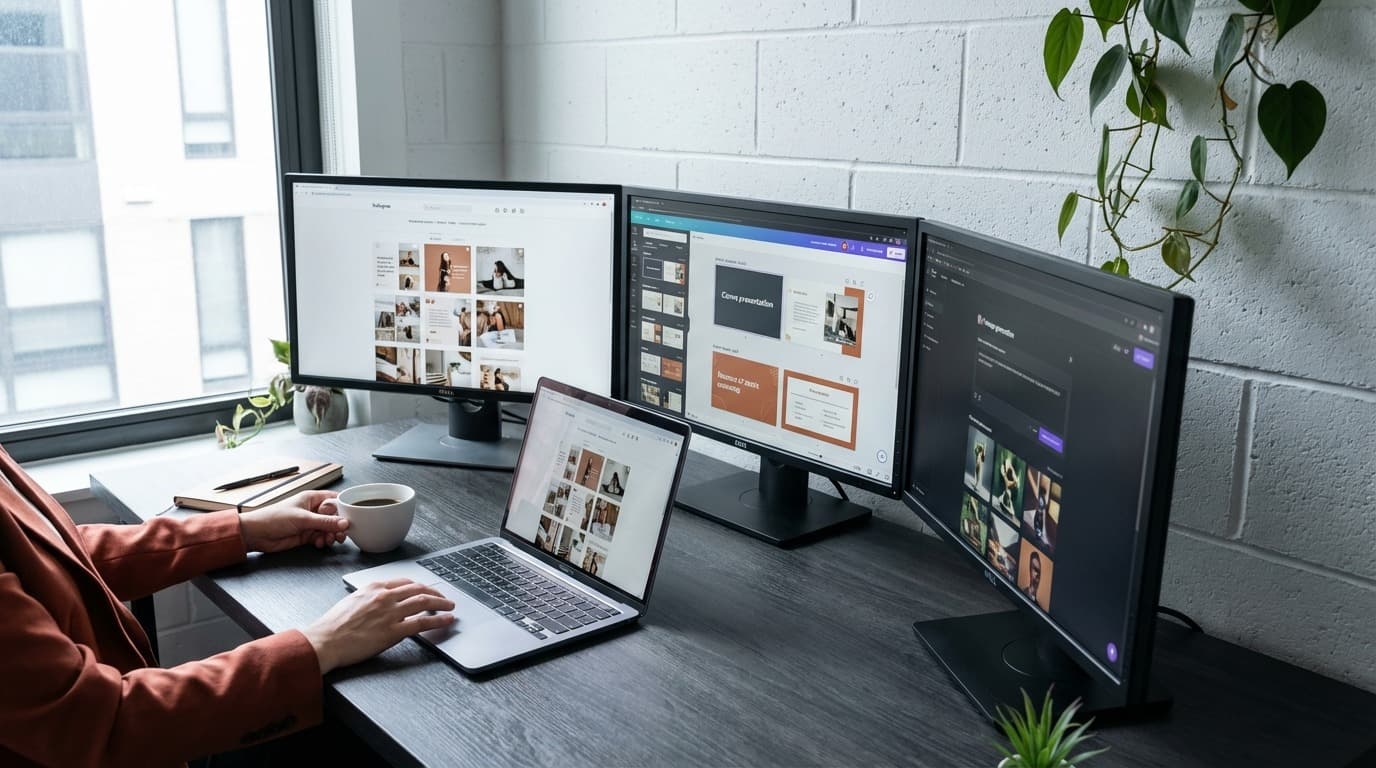
How you present the work determines what you can charge. Dropping images into a Google Drive folder is not a package. A package is a structured Canva presentation with a strategy on page one, a content calendar on page two, a grid preview on page three, an image collection on page four, and a posting guide on page five. Then one Google Drive folder, properly named, with every file labelled and every format ready to publish. When a client opens that folder, they do not need to ask a single question. That experience is what turns a one-off project into a retained client, and it is the same delivery standard that separates agency-level work from freelance-level work across every AI service.
How to Price and Find Your First Clients
Pricing That Reflects Value Not Hours
A starter social media package of eight posts plus a content calendar typically ranges from 400 to 700 euros per month. A standard package of twelve posts plus the full delivery folder ranges from 800 to 1,200 euros. A premium package with strategy, captions, grid preview, and posting guide ranges from 1,500 to 2,000 euros. For ad creatives, a batch of five to eight images typically ranges from 300 to 800 euros, depending on complexity. Price based on the value of the output, not the hours spent. With AI, a standard package takes a day to produce once your workflow is established. Retainer pricing is always preferable to project pricing because it creates a predictable monthly income.
Starting Local to Build Your Portfolio Fast
Your first clients are already around you. The cafe near your house, the salon down the street, a friend with a small online business. Go to them with a specific offer, not a general pitch. Show up with a sample piece of content made specifically for their brand. Offer the first month at a reduced rate in exchange for a testimonial and permission to use the work in your portfolio. Two or three local clients give you the case studies that make pitching to any business anywhere in the world credible and immediate. For ad creatives, look for businesses already running paid ads, they have a budget, they understand advertising, and they always need more creatives to test. Anyone building this as their entry into AI freelancing will find that spec work and direct outreach consistently outperform passive approaches.
Moving From Local to Global
Once you have two or three case studies, your geographic constraint disappears. A business in another country does not need to send you a professional shoot. One phone photo, three questions, and you do the rest. Post your case studies on LinkedIn and Instagram, describe the process and the result in plain language, and let the portfolio do the work. Every project done well is a public demonstration of what you can produce for the next client.
Common Mistakes When Starting an AI Content Agency
Offering Too Many Services Before Mastering One
Social media content, ad creatives, thumbnails, video, and copywriting are all different services with different workflows and client conversations. Starting with all of them means being mediocre at all of them. Pick one. Get good at it. Land two or three clients. Then add a second service. The agencies that grow fast do one thing well and earn the right to expand from there.
Generating Without Researching First
Opening an AI image tool before studying the niche produces content that looks wrong. It may be technically impressive but it does not speak the visual language of the industry. Every client project starts with thirty minutes of niche research before a single prompt is written. That research is what makes your output feel specific rather than generic, and specific is what clients pay a premium for.
Underdelivering on Packaging
The images are forty percent of the job. The packaging, structure, naming, and presentation are the other sixty. A well-generated set of images dropped into a shared folder with no context is a disappointing experience. The way you deliver the work is part of the product. Invest the same care in how you present as you do in what you produce.
Final Thoughts
An AI content agency is one of the most accessible and immediately viable businesses available to anyone with a laptop and a few hours to learn the tools. The demand is already there. Every small business around you needs content. Every brand running ads needs new creatives. Every creator needs thumbnails. The question is whether they can find someone who delivers quickly, thinks strategically, and packages the work in a way that makes their life easier. Start with one niche, one client, and one service. Do it properly. Use the result to land the next one. If you want to learn the tools, prompts, and workflows that make this work, with step-by-step guidance and a community of women building the same thing, AK Academy is where to start.x
Start building professional AI skills today.
Explore AK Academy and choose the path that fits your goal: courses, workshops, community, corporate training, or teaching with us.
FAQ