
Interview
How Jenny Built an AI-Powered App to Help People Prove Coercive Control
with Jenny Rudd, Founder of Dispute Buddy, Mount Maunganui, New Zealand
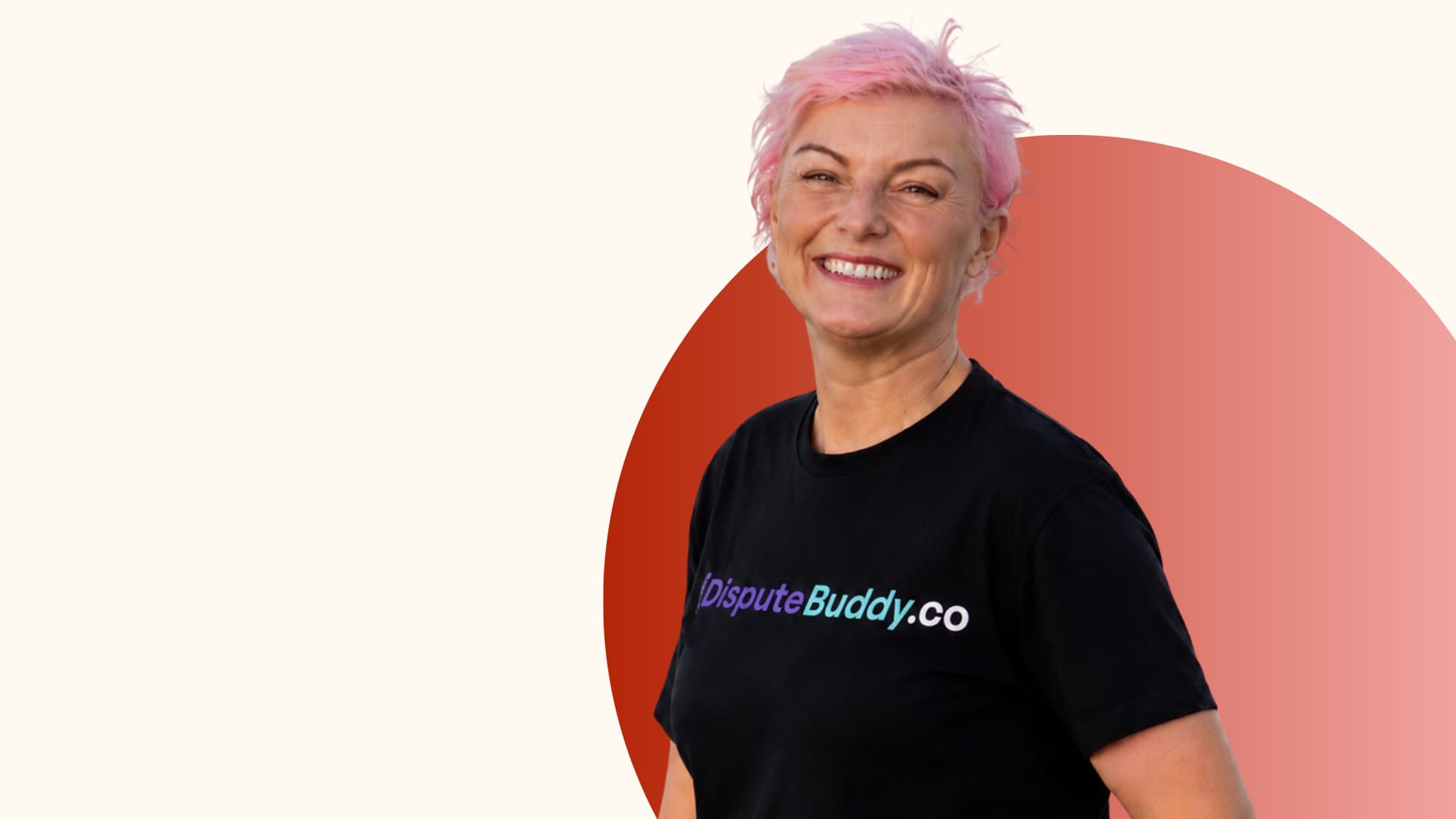
Meet Jenny
Jenny Rudd is the founder of Dispute Buddy, a desktop app that finds patterns of coercive control and emotional abuse in years of text messages and turns them into a lawyer-ready report, without the user ever having to read a single painful word. Before becoming a tech founder she built and sold a previous business against the advice of almost everyone around her, before a Family Court process and a long week of screenshotting changed the direction of her career entirely. She is based in Mount Maunganui, New Zealand, where she lives with her handsome husband and whichever of their five adult children happen to be home. She also runs the Gender Investment Gap project alongside Dame Theresa Gattung, measuring and working to close the gap in venture capital funding between women and men-founded startups.
In this interview, she talks about the 40 hours of screenshotting that made the product necessary, why she scrapped the entire codebase and rebuilt from scratch after every user cancelled their test session, how AI powers the behaviour analysis at the core of Dispute Buddy, and why she believes there has never been a better time to build tech products as a solo female founder.
The Interview
What is Dispute Buddy, and what does it actually do?
You can download Dispute Buddy's app to your computer, connect your iPhone, and enter contacts and a date range. The app will find patterns of coercive control and emotional abuse in years of texts and download a report you can give your lawyer.
We've built it in a way that feels like your big sister, who happens to be the world's best paralegal, is helping you get prepped for a lawyer. Our customers are in USA, UK, Australia and New Zealand.
What made you build Dispute Buddy?
I had to make an emergency Family Court application to protect my children. My ex-husband is a meth addict. My lawyer said: send me all your texts. I just assumed there was some platform that would suck everything out and organise them into what she needed. But there wasn't. I had to screenshot hundreds of messages, name every file in date order, organise them into folders by month, upload to a Dropbox, send it across. It took 30 to 40 hours. I had to take a week off my business. And the whole time I was doing it, I was re-reading every message, second-guessing everything. What if I missed the smoking gun? What would happen to my kids? I was completely traumatised by the process. When I finally sent it, my lawyer said: you are in the top 1 percent of quality of what we get when we ask for text messages to build a client's case. And I thought: if I can barely do this, with the time and the tech skills, who is doing this if they're working three jobs? If they can't take 40 hours off? If they don't have tech skills?
So I've built what I needed when I was sitting there scrolling through hundreds of messages, feeling sick to my stomach. I get such a kick out of knowing that what I felt is exactly what would have changed my life at the time. And that it's changing the lives of thousands of women and men all over the world.
Coercive control is something many people do not recognise while it is happening. Why do you think that is?
Because it doesn't look like what people think abuse looks like. There is no single moment you can point to. There is no broken nose. It's a pattern of small things, each of which sounds completely unremarkable when you say it out loud. When you get texts from the controlling partner, they always sound like they're from someone who cares about you. "Hey, I'm really worried about you. Can you text me when you get there and when you are coming back?" Then next time... "I felt like you weren't safe there. I don't think you should go there anymore." Alone, it's not alarming. But across years, across thousands of messages, the pattern is unmistakable. The problem is that when you are inside it, you're being told constantly that you are the problem. That is part of the mechanism. It is designed to make you doubt your own perception. Which makes it uniquely hard to prove and insane that the justice system puts the responsibility of finding evidence of coercive control on the person experiencing it.
I ran my own messages through Dispute Buddy when we built the behaviour analysis feature. The output said: "He has maintained a long-standing pattern of coercive control over Jenny." And even I, the person who built the business, who knows what coercive control is, my first thought was: oh, the system is exaggerating. It was probably partly my fault. That's how deep the conditioning goes. It doesn't turn off, even 13 years after leaving.
You scrapped the entire codebase and rebuilt from scratch. What made you do that?
We were at Techstars Sydney, a business accelerator, testing our prototype that had cost tens of thousands of dollars to build. And was the result of hundreds of customer discovery interviews. I'd set up three tests with people who were actively in disputes and had agreed to test it. Every single one of them cancelled. Different excuses. A sick child. A double booking.
My gut said: They're cancelling because they don't want to sit down and read a single painful word of those messages. That was the bit I'd underestimated. The problem wasn't speed. The problem was re-traumatisation. So we got rid of all of that code and started from scratch. The new product had to work without the user ever seeing any of their messages during the process. That became the foundational design principle and everything we have built since flows from that moment. So two days after our demo day at the end of the accelerator, I sat down with Seth, my CTO, and we redesigned the whole thing again from scratch. It felt like a huge 'take a deep breath' moment. But it was the right thing to do.
How did you get your first real customers after the rebuild?
This was a real massive challenge for us, because no one wants to connect their iPhone to your untested tech when they're going through one of the most painful experiences of their life. Our big break came when Angela Harbinson, the CEO and founder of theseparationguide.com.au, allowed us to run a promotion on her platform, which is Australia's biggest divorce tech platform. It was a six-week promotion, and we offered it for free to her user base. On day one, 14 people downloaded the app, and on the last day of the promotion, over a hundred people downloaded it. It was incredible. It gave us the start that we needed and real use cases for us to really test our tech. Early users had to connect a phone, find a hard drive, wait up to 14 hours for the app to index, and then click export, which sometimes crashed. All it produced at that point was a chronology. Not the in-depth behaviour analysis we do now.
I cannot believe anyone stayed with us. It was such a pain to use at the beginning! But they did, and without them we would never have got the product to where it is now.
What did the first real sale feel like?
I remember the first actual sale so well. I was at Dee Why Beach in Sydney with a friend when my phone went 'bing'. I opened our Stripe account and there was a successful payment in there! That woman used the app in her custody case and got a parenting order for her children.
That was like rocket fuel for my motivation. We are now selling in the USA, UK, Australia and New Zealand. We get daily messages from people in tears saying they couldn't have done it without us. That's what turns up in our inbox every day. It's very special.
You were in your late 40s with no engineering background. How did you think about those odds?
I actually knew the odds really well because in New Zealand I run a project called the Gender Investment Gap with Dame Theresa Gattung. We measure and close the gap in venture capital that goes to women and men-founded startups. But I leaned into what I knew. I'd bought a business before, that everyone had advised against. My husband and I grew it and sold it for an unheard-of multiple in our industry. I tend to think the data doesn't apply to me (haha). I'll just figure it out and get it done. I don't care about failing. I care about having a go. I understood customers, I understood product, I understood how to systematise things.
What I brought was the domain knowledge, the customer obsession, and the complete inability to stop. I am just relentless. I think that is the actual quality that matters. I also think being a bit older helped. I have a much higher tolerance for discomfort at 50 than I did at 25. I have been through enough hard things to know that hard things are survivable. The engineering thing was really tough to solve. But I have ended up with one of Australia's most talented engineers, Seth Bell. He's a legend.
How does AI power what Dispute Buddy does, and how do you use it in your own work?
Inside the product, we use our own AI analysis to find patterns across years of texts. That's the core of what makes Dispute Buddy different. It isn't extracting texts. It is identifying behaviour. The model finds patterns of coercion, manipulation, financial control, threats across years of messages and presents them in a way that is useful for lawyers to build cases. The data never leaves the user's device, and the analysis is immediately deleted from the cloud after the report is generated. That's a deliberate design choice. Beyond the product, I use AI in my own work every single day. It's across everything: customer support, product strategy, copy, working through a hard problem.
What has changed isn't just speed. It is that I can now operate as a serious product founder without an enormous team. The access to that quality of thinking, right there, is one of the things that actually dismantled the barriers that used to keep businesses like mine small.
What has been the hardest part of building something this personal?
We help people in the hardest moments of their lives. Every customer who buys Dispute Buddy is scared, overwhelmed, exhausted. That isn't abstract to me. I know exactly what that feels like. So when something goes wrong, a file doesn't process, the app crashes, there's a bug, it isn't just a support ticket. It's a real person in the worst moment of their life.
It's a privilege to help them, but there's also a lot of responsibility.
What would you say to a woman who is hesitating to start something that matters to her?
If you feel like you can't not do this thing in your mind, just get on and do it. There has never been a better time to build tech products as a solo female founder. Not only has AI made it possible to build apps (get onto YouTube and follow a few tutorials!), but there is a vast market opportunity to build products designed for women, who have been largely ignored by male investors and tech founders.
It's an enormous privilege to work on solving a problem you care about. I wake up with a fire in my tummy every single day. I go for an ocean swim to cool down, then I'm into it!
JOIN AK ACADEMY
AK Academy brings together courses, workshops, interviews, and a community to help women build practical AI skills for real professional use.